Stabilising bridge repairs completed before spawning season
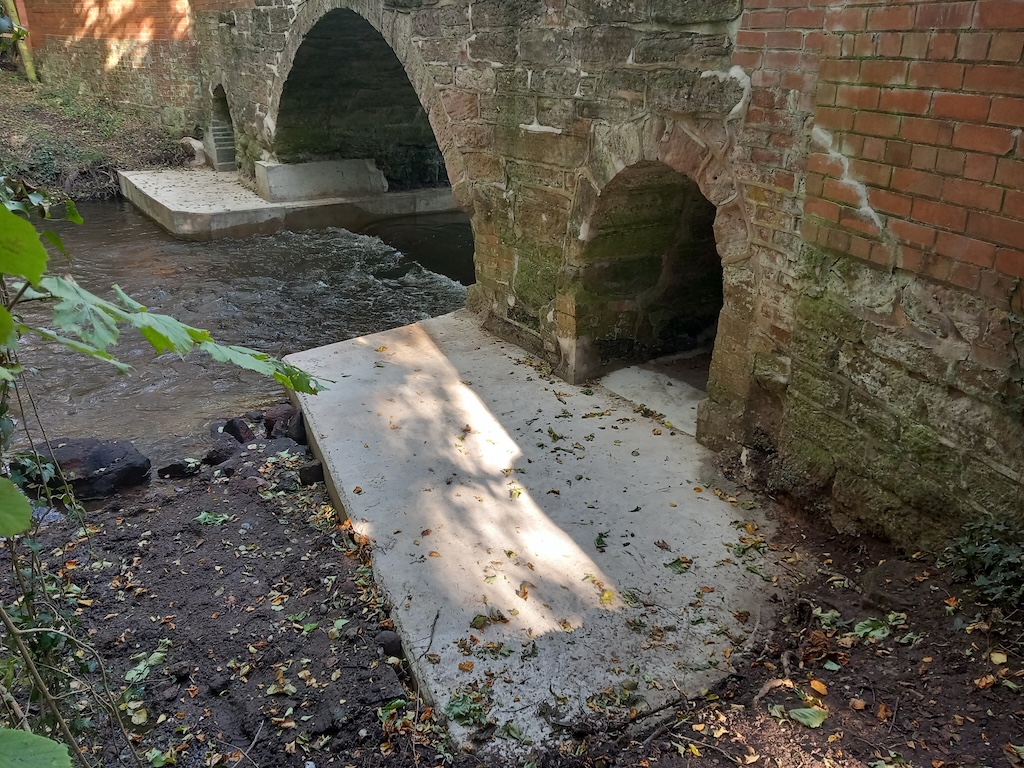
Construction specialists McPhillips successfully completed complex civil engineering repairs to a bridge over the River Meese in Telford before the start of the all-important fish spawning season.
Through meticulous planning, adaptable work methods, and strict adherence to environmental protocols, the team successfully restored the structural integrity of the bridge while protecting the surrounding ecosystem.
Fish within the working area had to be gently removed and relocated prior to the start of stabilising and strengthening works to the single span masonry arch Sheep Bridge on the B429 in Cherrington.
Strict environmental safeguards were integral to the project in order to protect the river’s ecosystem and involved daily decontamination protocols to prevent cross contamination from harmful American crayfish.
The works, which took just seven weeks, saw the installation of a large portable dam to control water flow and enable the McPhillips team to work in the riverbed.
Defective concrete aprons supporting the bridge were removed and replaced to protect its stability and longevity, along with repairs to missing stonework and flood relief arches.
McPhillips director Andrew Dunham said: “The existing scour protection was being undercut, with evidence that water was travelling beneath parts of the structure, threatening the bridge’s stability and longevity.
“The scope included stabilising and strengthening the arch support to repair undercutting, installation of scour protection works, removal of existing defective concrete aprons, and replacement with mass concrete alongside and underneath the abutments of the central arch. Isolated spalled and missing stonework in the central arch and flood relief arches were also replaced.
“This 7-week NEC 4 Sub-Contract Framework project was delivered on time for Balfour Beatty, and completed with zero defects.”
The Sheep Bridge repair project presented several significant challenges that required careful planning and management.
- Working in a live river environment: The team had to develop solutions for working in unstable riverbed conditions while managing water flow.
- Environmental constraints: Strict environmental controls were necessary to protect the river ecosystem. Work needed to be completed before the fish spawning season beginning 1st October.
- Load-bearing considerations: The use of a nine-ton excavator on a bridge with a posted 3-ton limit required advance structural surveys and careful management of load distribution.
- Access limitations: The confined spaces beneath the bridge limited access for concrete pumping equipment, requiring alternative material handling solutions.
McPhillips adopted a tailored approach was developed to address the unique challenges presented by the Sheep Bridge environment. Key elements of the execution included:
- Comprehensive environmental management: Recognising the critical importance of protecting the river ecosystem, the team implemented a fishery permit process with careful removal and relocation of fish using electric stunning techniques. All fish were safely scooped out before work began in the river. The team also rigorously monitored and removed invasive American crayfish, which carry a disease harmful to native species, and implemented daily decontamination protocols to prevent cross-site contamination.
- Phased construction methodology: To maintain structural stability throughout the works, the team implemented a carefully sequenced construction approach. This involved dividing the bridge into four quadrants that could be completed sequentially while maintaining the integrity of the structure.
- Controlled water management: The Porter Dam installation with 4 tons of sandbags allowed the team to pump out water daily, with twice-daily checks to prevent failures.
- Specialised material application: The use of high-strength concrete, allowing walk-on strength within two hours, was crucial for the tight schedule and challenging river environment.
McPhillips site manager Simon Walker said: “This was a really interesting project to work on and despite the challenges, watching the team adapt and problem-solve was brilliant. It was a great team effort working with Porta Dam and McPhillips operatives, protecting local wildlife and delivering awkward concrete pours in difficult conditions.
“There’s something really satisfying about standing back and seeing what we’ve accomplished, knowing that our work has secured that bridge for years to come. I’m really proud of how the McPhillips team pulled together and made it happen.”
The bridge had to be closed during the day Monday to Friday, but reopened at night and weekends to allow access for pedestrians, cyclists and horse riders.